Client onboarding and verification
More data per client.
Fewer requests to them.
Collect information once.
Use it in every office.
AMLR prescribes what’s collected, how it’s verified and who’s checked. First AML applies it with each country’s rules and the firm’s policy, office by office, on one client record. Clients are asked once and every check is logged.
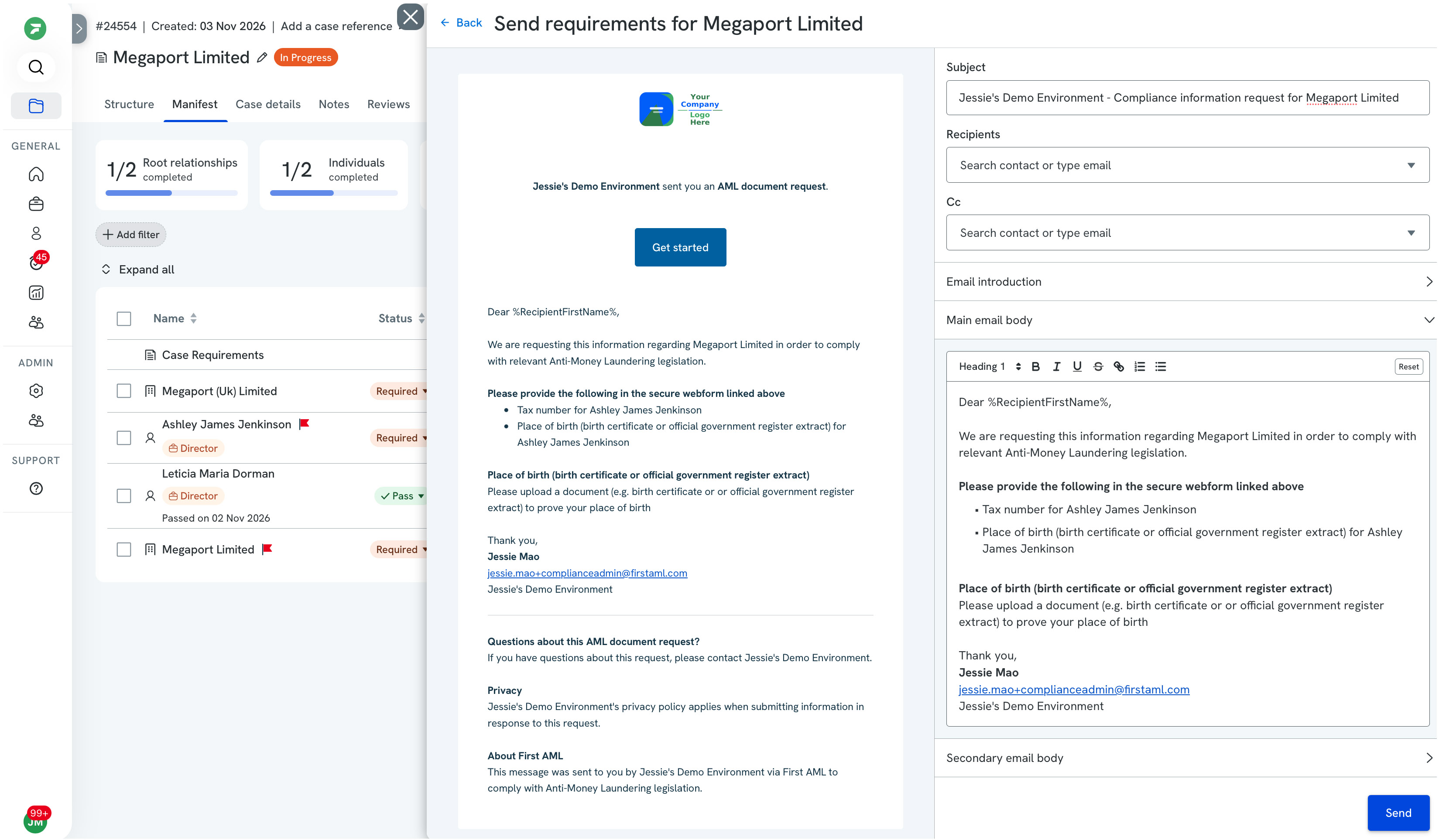
Turns requirements into one clear client request.
One secure request to the client’s main contact covers every owner and representative, with automatic reminders from the firm's own domain. Screening runs as soon as the case opens and returning clients aren’t asked for the same information again.
Proves policy in practice.
Each case shows the rule that required each check, who completed it and when, the route used and the result. A case can’t close until every required check is done. The register check is logged as its own step.
"First AML removes some of the discretion and that levels the skill gap that we have between our most senior members of the team and our most junior."
- Global law firm, 30+ countries, 40+ offices
Keeps one record across multiple offices.
When a client has matters in London and Paris, everything already verified is appropriately accessible.
Each matter adds only what the rules of the office doing the work require, so the Paris matter asks for place of birth and tax number and the London matter doesn’t.
Open requests are flagged across offices, so the client isn’t asked twice.
Applies each country’s rules to one client record.
Every EU office answers to three sets of rules: AMLR, its own country’s additions and the firm’s policy. First AML handles all three with:
- out-of-the-box regulatory-specific rules
- a firm-wide standard that every office inherits
- country and office rules on top, where local requirements or firm policy differs
- configuration the compliance team handles, without involving IT
When any layer changes, it’s updated once by the compliance team and every new case follows.
Verification methods
AMLR defines the routes: a passport, ID document or equivalent, or eIDAS digital ID at substantial or high assurance.
Beneficial owners keep a separate reasonable-measures route. First AML sets the allowed routes per office, adds eIDAS for EU offices, and verifies beneficial owners from registry data and documents in the same case.
Who needs checking
AMLR names more parties. Both sides of the transaction are covered for estate agents and sole legal intermediaries, and so is anyone on whose behalf, or for whose benefit, the work is done.
First AML holds every party in one case, each tagged by role, and screens each one as soon as the case opens.
What’s collected, and where
AMLR’s data fields apply at EU offices, not UK ones. First AML captures each field as structured data, required in Paris and switched off in London.
Beneficial owners are identified from the structure and carry the same identity data. Identity is verified in 180+ countries, with electronic database checks where national data supports them.
Frequently asked questions
How are clients handled when their matters fall under both AMLR and the UK MLRs?
Each matter follows the rules of the office doing the work. The client keeps one record, verified data carries across offices and each office collects only what its own rules add. The file shows which standard applied to each matter.
How are regulatory rules kept current as AMLA finalises its standards?
First AML maintains out-of-the-box regulatory rules and updates them as AMLA standards and national rules are finalised. Nothing changes automatically. The firm’s compliance team reviews each update and decides when it goes live, office by office.
Who supports the firm through implementation and after go-live?
People who have done AML themselves. First AML ran more than two million AML cases for firms before it built the platform, and its implementation and support teams come from compliance roles. They set the platform up to each jurisdiction’s guidance with the firm’s compliance team and stay involved after go-live.
What happens to existing clients on 10 July 2027?
Existing clients move onto AMLR’s review cycle. Each client’s last-verified date carries over, reviews fall due by due diligence level, and the new identity fields are collected at each review.
How is client data controlled across offices and jurisdictions?
EU accounts are hosted in Ireland, with disaster recovery in Frankfurt. Each office sees the data its own rules require, and documents a jurisdiction doesn’t need are restricted there. Every action is logged against the user who took it.
Who sets up each jurisdiction before July 2027?
First AML’s implementation team works with the firm’s compliance team, office by office, to configure rules, risk assessments and requirements to each jurisdiction’s guidance. Once the platform is live, the compliance team changes them without involving IT or First AML