Business verification for faster ownership analysis
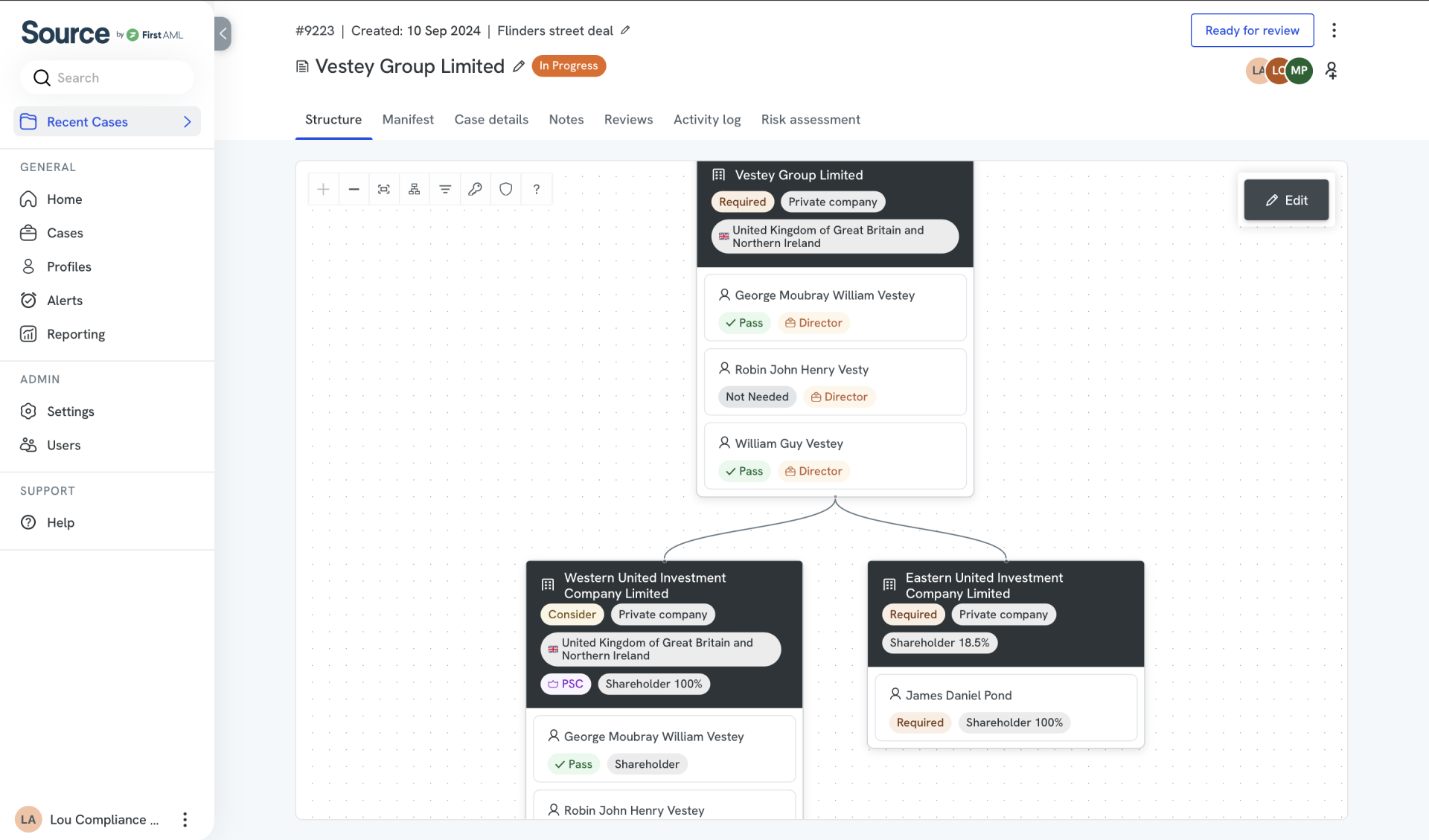
Map, identify and verify who’s really in control of complex entities.
First AML maps business ownership using trusted registries across 200+ jurisdictions, surfacing shareholdings, share classes and control relationships so teams can quickly see who owns what, where complexity sits and what policies, processes and verification steps to follow next.
Layer cake
See through layered structures
Entity and ownership structures are automatically built from global registry data. Complex structures are auto-mapped and trigger deeper checks based on type, jurisdiction and risk - without manual reconstruction or rule-by-rule interpretation.
Who's counting
Know who owns the business
Ownership percentages are automatically calculated across every entity layer to surface UBOs and persons with effective control. Complex ownership positions are surfaced clearly for review - without manual estimates stitched together from multiple registries.
Sure footing
Drive the next compliance step
Ownership findings are embedded directly into the compliance workflow, linking business verification to risk assessments, document collection, approvals and escalation paths. The next right step follows automatically, while rules set by your compliance team determine what happens next.
How it works
Step 1.
Verify the business
Search and verify companies using trusted registries across 200+ jurisdictions. Capture directors, shareholders and registration details in one step.
Step 2.
Unwrap the ownership structure
Entity relationships are analysed and a visual map is generated showing how individuals and entities connect - across every ownership layer.
Step 3.
Identify beneficial owners
Ownership percentages are calculated automatically across every layer to reveal ultimate beneficial owners and persons with effective control.
Step 4.
Review and document
Capture supporting documents, ownership analysis and verification evidence within the AML case. The record is complete before the case moves forward.
Keep moving when structures
get messy
Ownership analysis you can rely on, backed by tools to uncover hidden control across layered and offshore structures.
Follow the structure beyond the first registry result
Holding companies, trusts, offshore entities and nominee arrangements can be worked through using automated record requests, manual entity addition and automated document analysis to uncover ownership that registries alone do not show.
Work the case. Defend the decision.
Registry data, ownership calculations and supporting documents sit together in the AML case. Teams can flag gaps, adjust structures and record rationale, assumptions and investigative steps as the analysis develops.
Verification findings automatically follow risk controls
Ownership analysis connects directly to risk assessments and AML controls. Complexity, jurisdiction and beneficial owner risk trigger additional checks, approvals and review cycles automatically.
Frequently Asked Questions
How does the system identify the ultimate beneficial owners of a company?
First AML calls in the company extract and registry records for the entity being verified. It automatically analyses directors, shareholders and related entities, then builds out the wider ownership chain layer by layer.
Shareholdings, share classes, voting rights and control relationships are surfaced across the structure and ownership percentages are calculated automatically (based on jurisdiction or your compliance policy) to identify ultimate beneficial owners and individuals with effective control. This all happens automatically without requiring manual analysis of individual documents.
Can the system handle complex ownership structures?
Yes. First AML is built for structures that go beyond a simple company extract, including holding companies, trusts, offshore entities, nominees and private entities with limited disclosure. When registry data does not fully explain the structure, additional records, documents and manual entity additions can be used to keep building out the ownership picture.
What corporate registries does the platform use?
First AML connects to trusted corporate registries and data sources across more than 200 jurisdictions. Registry data is combined with ownership analysis to surface directors, shareholders, share classes and entity relationships, allowing compliance teams to investigate ownership structures that span multiple jurisdictions. A full list of the data sources can be provided upon request.
How does business verification connect to the rest of the AML workflow?
Business verification links directly to risk assessments, document collection and escalation pathways. The outcome of a business verification check feeds the next compliance step automatically, based on rules configured by your compliance team and aligned to your AML policy.
How does First AML support a proportionate, risk-based approach to business verification?
Ownership findings feed directly into risk assessments, helping firms calibrate due diligence based on actual ownership and control. That means higher scrutiny where structures are complex or higher risk, without applying the same level of review to every business client.
How can firms evidence how beneficial ownership was determined?
First AML keeps registry data, ownership calculations, structure charts and supporting documents together within the AML case. When regulators ask how beneficial ownership was determined, compliance teams can show the structure analysed, the evidence reviewed and the reasoning behind the final decision.
Why firms trust First AML
Built on real AML experience
We processed over 2 million AML cases ourselves before building the platform - so it’s shaped by what works in practice.
Local support that understands compliance
Our Customer Success team is based in-market and works alongside local firms and consultants to help turn policies into day-to-day workflows.
Solutions, not sales pitches
We take a solution-led approach, configuring First AML around your risk framework, operating model and regulatory context.
See First AML in action.
The only AML platform you need to run world-class onboarding.